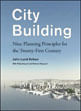
Good city building is not created by complex statistics, functional problem solving, or any particular decision-making process. Successful cities instead come from people advocating easily understood human values and principles that take into account the sensory, tactile, and sustainable qualities of environment and design in relation to what is the best of human endeavor.
From the introduction to City Building
Cities are often viewed as the least-healthy environments for humans because they are centers of pollution, overcrowdedness, and waste. But the opposite can be true. A well-planned city can be a model of sustainable living. Good city building counters the sprawl of suburbia with concentrated land use, replaces globalized design with regionally appropriate building types, and allows for livable, desirable neighborhoods. John Lund Kriken and Philip Enquist, both longtime partners in the preeminent and award-winning planning firm Skidmore, Owings & Merrill(SOM) have collaborated with writer Richard Rapaport to create City Building.
This proactive, green-focused, user-friendly guide to city building is organized into three parts: Part one examines the past and defines the current practice of city building, addressing its shortcomings and proposing a comprehensive framework for rethinking the approach to cities in the future. Part two translates this framework into nine best-practice principles that are common to successful, livable, urban environments: sustainability, accessibility, diversity, open space, compatibility, incentives, adaptability, density, and identity. These principles are illustrated in a global portfolio of city building projects, designed by SOM, that show how best practices have been applied successfully. Part three makes the case that, far from being the problem, cities, properly organized, can be a mechanism for sensible, sustainable uses of increasingly scarce resources. The book concludes with a call for a national planning process