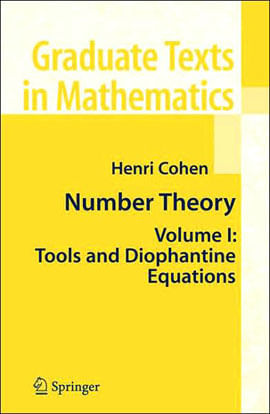
Caderno Lireo65
Educação
Educação
Como acompanhar a leitura dos alunos sem aplicar prova
A prova de livro é um termômetro ruim: só mede quem leu o resumo. Conheça métodos que avaliam a leitura de verdade e ainda aumentam o engajamento dos alunos.
Crie uma conta gratuita e continue exatamente desta página.
Crie uma conta gratuita e continue exatamente desta página.
The central theme is the solution of Diophantine equations, i.e., equations or systems of polynomial equations which must be solved in integers, rational numbers or more generally in algebraic numbers. This theme, in particular, is the central motivation for the modern theory of arithmetic algebraic geometry. In this text, this is considered through three of its most basic aspects. The first is the local aspect: one can do analysis in p-adic fields, and here the author starts by looking at solutions in finite fields, then proceeds to lift these solutions to local solutions using Hensel lifting. The second aspect is the global aspect: the use of number fields, and in particular of class groups and unit groups. The third aspect is the theoryof zeta and L-functions. This last aspect can be considered as a unifying theme for the whole subject, and embodies in a beautiful way the local and global aspects of Diophantine problems. In fact, these functions are defined through the local aspects of the problems, but their analytic behavior is intimately linked to the global aspects. Much more sophisticated techniques have been brought to bear on the subject of Diophantine equations, and for this reason, the author has included 5 appendices on these techniques. These appendices were written by Henri Cohen, Yann Bugeaud, Maurice Mignotte, Sylvain Duquesne, and Samir Siksek, and contain material on the use of Galois representations, the superfermat equation, Mihailescu’s proof of Catalan’s Conjecture, and applications of linear forms in logarithms.
Livros na mesma categoria

E: a HistóRia de um NúMero
Eli Maor
Oxford Hand. Of Philosophy Of Math. And Logic, The
Stewart Shapiro

Chemistry
Steven S. | Zumdahl Susan a. Zumdahl
Sidereus Nuncius - o Mensageiro das Estrelas
Galileu Galilei

Knowledge From The Stars
Wesley H. Bateman

A Filosofia das CiêNcias
Dominique Lecourt

Entre Newton e Einstein Desm. o Conc. de Saude
Elaine Morelato Vilela

Electrolyte Solutions 2nd Revised Edition
R.a. Robinson
Aspects Of Quantum Field Theory In Curved Spacetim
Stephen a. Fulling
Differential Geometry Of Curves And Surfaces
Victor a. Toponogov

Radiação
Emico Okuno

Cientifica - o Guia Completo do Mundo da Ciencia
Allan R. Glanville
Dicas e recomendações para leitores
A prova de livro é um termômetro ruim: só mede quem leu o resumo. Conheça métodos que avaliam a leitura de verdade e ainda aumentam o engajamento dos alunos.
Clubes de leitura escolares aumentam o engajamento, reduzem o abandono da leitura e criam laços entre alunos. Um guia prático para professores que querem montar o seu.
O aluno que lê por obrigação raramente vira leitor. Mas há formas de apresentar a leitura escolar que mudam essa equação. Veja o que a pesquisa diz e como professores estão fazendo diferente.
Para escolas, universidades, autores e editoras