
Por que alunos que leem mais vão melhor em todas as matérias
Não é intuição, é ciência: o hábito de leitura correlaciona com melhor desempenho em matemática, ciências e redação. Veja o que a pesquisa comprova e o que a escola pode fazer.
Crie uma conta gratuita e continue exatamente desta página.
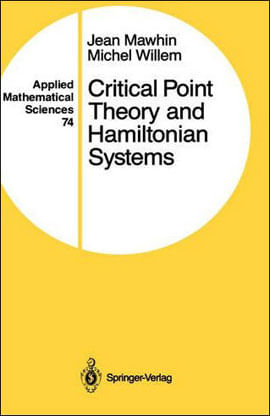
The last decade has seen a tremendous development in critical point theory in infinite dimensional spaces and its application to nonlinear boundary value problems. In particular, striking results were obtained in the classical problem of periodic solutions of Hamiltonian systems. This book provides a systematic presentation of the most basic tools of critical point theory: minimization, convex functions and Fenchel transform, dual least action principle, Ekeland variational principle, minimax methods, Lusternik- Schirelmann theory for Z2 and S1 symmetries, Morse theory for possibly degenerate critical points and non-degenerate critical manifolds. Each technique is illustrated by applications to the discussion of the existence, multiplicity, and bifurcation of the periodic solutions of Hamiltonian systems. Among the treated questions are the periodic solutions with fixed period or fixed energy of autonomous systems, the existence of subharmonics in the non-autonomous case, the asymptotically linear Hamiltonian systems, free and forced superlinear problems. Application of those results to the equations of mechanical pendulum, to Josephson systems of solid state physics and to questions from celestial mechanics are given. The aim of the book is to introduce a reader familiar to more classical techniques of ordinary differential equations to the powerful approach of modern critical point theory. The style of the exposition has been adapted to this goal. The new topological tools are introduced in a progressive but detailed way and immediately applied to differential equation problems. The abstract tools can also be applied to partial differential equations and the reader will also find the basic references in this direction in the bibliography of more than 500 items which concludes the book.
Planeje no seu ritmo
Esta edição tem 277 páginas. Escolha uma meta diária possível e ajuste o plano conforme a leitura avançar.
Ritmo tranquilo
28 dias
10 páginas por dia
Ritmo constante
14 dias
20 páginas por dia
Ritmo intenso
10 dias
30 páginas por dia
Livros na mesma categoria
Sua vida de leitura
A Lireo é uma plataforma para organizar sua estante, registrar páginas e impressões, publicar resenhas e encontrar pessoas que estão lendo os mesmos livros.
Dicas e recomendações para leitores
Não é intuição, é ciência: o hábito de leitura correlaciona com melhor desempenho em matemática, ciências e redação. Veja o que a pesquisa comprova e o que a escola pode fazer.
Ciência confirma: ler regularmente melhora a memória, reduz o estresse e aumenta a empatia. Veja o que a pesquisa diz e como incorporar a leitura na sua rotina.
Você começa a ler com entusiasmo e para depois de uma semana. Conheça a ciência por trás da formação de hábitos e as estratégias práticas para finalmente fazer a leitura grudar.
Para escolas, universidades, autores e editoras