
Por que alunos que leem mais vão melhor em todas as matérias
Não é intuição, é ciência: o hábito de leitura correlaciona com melhor desempenho em matemática, ciências e redação. Veja o que a pesquisa comprova e o que a escola pode fazer.
Crie uma conta gratuita e continue exatamente desta página.
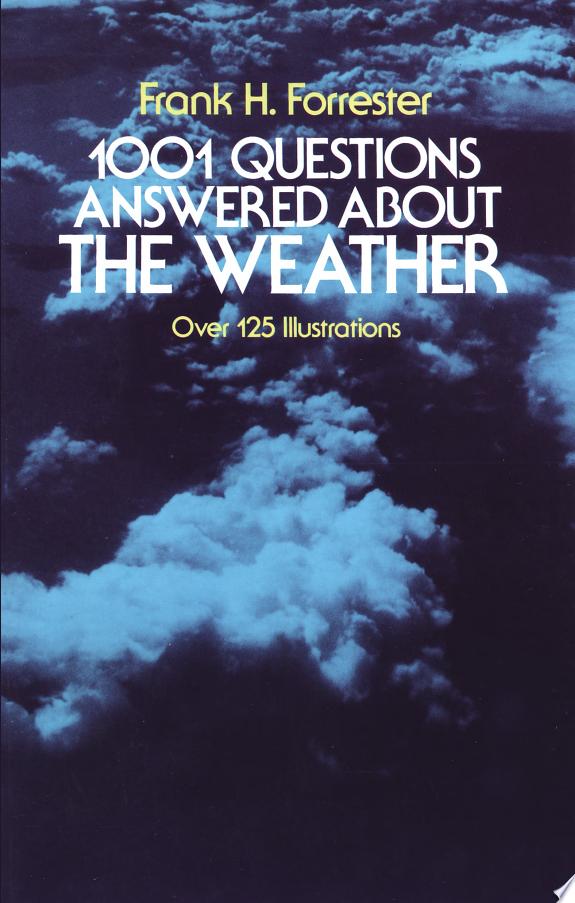
What causes the aurora? What are the trade winds? Why are good and bad weather associated with highs and lows respectively? What is a high; a low? Anyone puzzled by weather people flaunting stationary fronts, rising barometers, and 100% humidity without rain, will find enlightenment and more in this compact encyclopedia of weather. Arranged in a question-and-answer format, it is by no means a simple quiz book or dry academic text; the format permits logical thought progression from basic to complex, always isolating, highlighting, and clarifying the crucial points. Answers rarely confine themselves to a single sentence -- most receive full paragraphs, supported by diagrams, full-page illustrations and a section of 34 black-and-white photographs. The book begins where the weather does, with the sun, and proceeds to the atmosphere, wind and storm, climatology, medical meteorology, weather lore, historical weather studies, how to be weather wise. Readers will discover why two people can never see the same rainbow; the highest and lowest temperatures ever recorded; the meteorological downfalls of Alexander the Great, Cambyses, the Spanish Armada and Napoleon; whether lightning strikes twice in one place; the forecasting validity of Groundhog Day; and how air temperature can be accurately measured by a cricket's chirp. This corrected edition includes a new Preface by the author (former Information Officer, U.S. Geological Survey) on recent developments in meteorology. Students and readers with minimal science background will find the exposition immediately comprehensive and the answers as fascinating as the weather is variable.
Planeje no seu ritmo
Esta edição tem 464 páginas. Escolha uma meta diária possível e ajuste o plano conforme a leitura avançar.
Ritmo tranquilo
47 dias
10 páginas por dia
Ritmo constante
24 dias
20 páginas por dia
Ritmo intenso
16 dias
30 páginas por dia
Livros na mesma categoria
Sua vida de leitura
A Lireo é uma plataforma para organizar sua estante, registrar páginas e impressões, publicar resenhas e encontrar pessoas que estão lendo os mesmos livros.
Dicas e recomendações para leitores
Não é intuição, é ciência: o hábito de leitura correlaciona com melhor desempenho em matemática, ciências e redação. Veja o que a pesquisa comprova e o que a escola pode fazer.
Ciência confirma: ler regularmente melhora a memória, reduz o estresse e aumenta a empatia. Veja o que a pesquisa diz e como incorporar a leitura na sua rotina.
Você começa a ler com entusiasmo e para depois de uma semana. Conheça a ciência por trás da formação de hábitos e as estratégias práticas para finalmente fazer a leitura grudar.
Para escolas, universidades, autores e editoras